![[STAGING] Hudson Memory](https://staging.hudsonmemory.org/wp-content/uploads/2026/03/cropped-Hudson-Memory-Logo.webp)
![[STAGING] Hudson Memory](https://staging.hudsonmemory.org/wp-content/uploads/2026/03/Hudson-Memory-Logo-mobile.png)
Christ Church Episcopal
The story of the old Christ Church Episcopal building, now lost to time
by James F. Caccamo, Ex Libris, March 1983
Although Episcopalians were living in Hudson in the 1830’s, the roots of the Episcopal Church here date back to 1840, when an effort was begun to establish a formal congregation. The Parish of Christ Church Episcopal was formally organized on July 11, 1842. The parish used various sites for services including the Brick Academy and the upstairs of Anson Brewster’s store at the corner of Main and Aurora Streets. Anson Brewster, along with other stalwarts of the Church such as his brother-in-law Dr. Israel Town, supported the new parish.
On January 6, 1846, 37 parishioners gathered to discuss the erection of a church building in Hudson. Anson Brewster donated a lot on the Public Square near his store, and the cornerstone of the original Christ Church Episcopal was laid in April of 1846. It was a clapboard church done in a Gothic style. It included a steeple surrounded by four spires; there were also spires on the four corners of the main building.
In 1849, Anson Brewster donated a clock to the church for use in the tower. This original clock on the Green had four faces and was placed just below the spire. D.H. Arnold donated the bell, which was salvaged when the church was demolished in April of 1930 to make way for construction of a new church building. The bell is now in use in the new church.
The church lasted until 1930, lending a Gothic presence to the Green that was enhanced by the Gothic beauty of its companion building, the Brewster Mansion. It is obvious that Anson Brewster’s tastes must have influenced the design of the church.
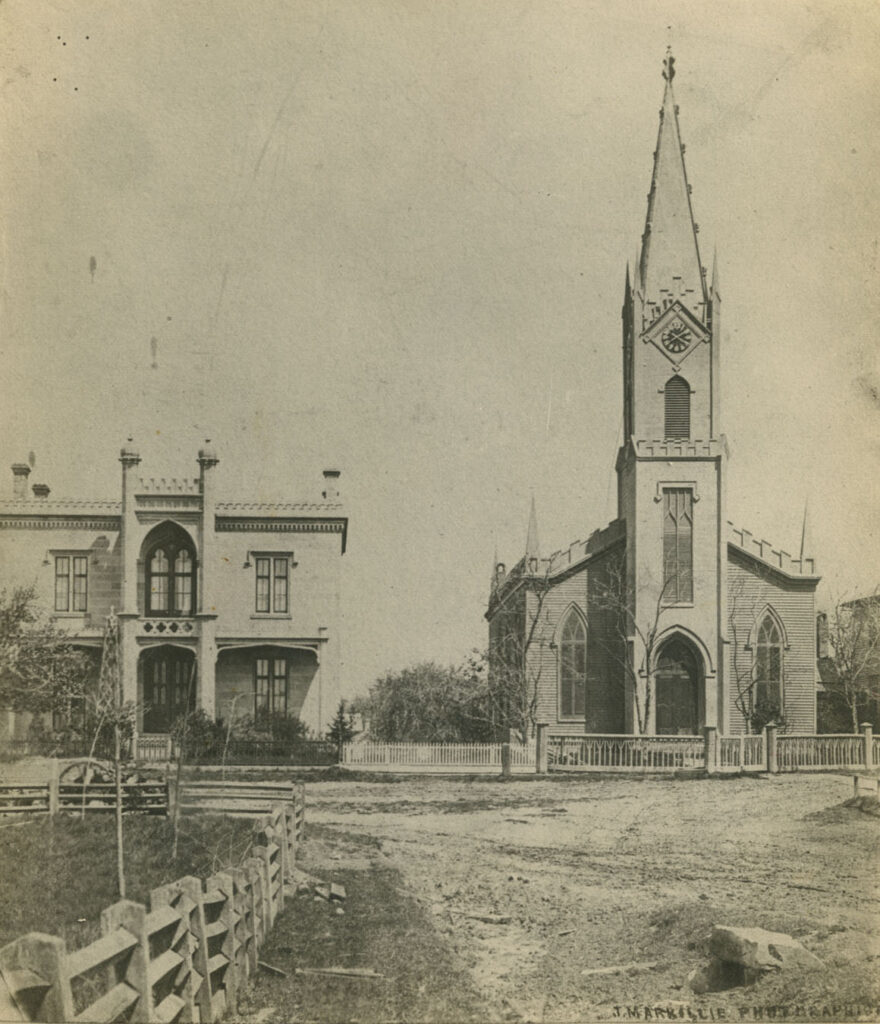
In later years, the steeple was removed and clockfaces taken out and boarded over. This greatly altered the church’s Gothic appearance.
As early as 1926, the congregation began to work for a new church building. In that year, some land north of the town was donated to the church, but it was never used. The original intention was not to tear down the old church, but to build a new one and secularize the old building, much like St. Mary’s Catholic Church did in the 1960’s. However, a change in pastors and economic factors, (as well as the prestige of having a church facing the Green) led the congregation to decide to tear down the 1846 church, which at the time of its destruction was the oldest standing church building in Hudson.
On April 27, 1930, the old Gothic church was secularized, and demolition began the next day. The replacement, a Christopher Wren-inspired Georgian structure, was completed in November, and the dedication was held on November 30, 1930.

The net effect of the loss of the original building is great. Not only was the Green area permanently altered in character, but the lovely stone Gothic Brewster Mansion next door lost what was tantamount to a companion piece. Modern viewers who see the Brewster Mansion as an anomaly among Hudson buildings are seeing it out of context.
One of the most unusual aspects of the Christ Church Episcopal is that that local paper does not include a single letter protesting the demolition, nor did anyone propose saving the structure by moving it. Perhaps the graceful beauty of the replacement church pacified the town’s sentiments. This is a striking contrast to public reaction concerning the proposed demolition of the Brewster Store two doors to the west on Aurora Street three decades later. Public outcry saved that building from destruction. Anson Brewster’s dream of a line of Gothic buildings along Aurora Street was not so fortunate.